
Chronological Age Calculator – Precise Years, Months & Days
Calculate your exact age down to the day. The tool automatically accounts for leap years, different month lengths, and other calendar details, giving you accurate results for school admissions, medical records, legal age verification, and more.
All calculations follow Gregorian calendar rules.
How we calculate your exact chronological age
This tool uses a calendar-aware algorithm, not simple division. Here’s how the precise age is computed:
- Years: Count how many full birthday anniversaries have passed. If today is before your birthday this year, subtract one year. On non-leap years, Feb 29 birthdays are treated as Feb 28 for comparison.
- Remaining months: From the last anniversary, count complete months until the as-of date. A month is “complete” only when the day-of-month in the as-of date is ≥ your birth day (with end-of-month clamping for short months).
- Remaining days: The calendar days between the last fully-counted month-anniversary and the as-of date.
- Total months:
years × 12 + monthsfrom step 1–2. - Total days: Exact millisecond difference between the two dates converted to whole days —
Math.floor(ms / 86400000)— so every leap day is counted precisely.
This is the same chronological age formula used in pediatric growth chart references and legal age-of-majority calculations.
Understanding Chronological Age vs. Biological Age
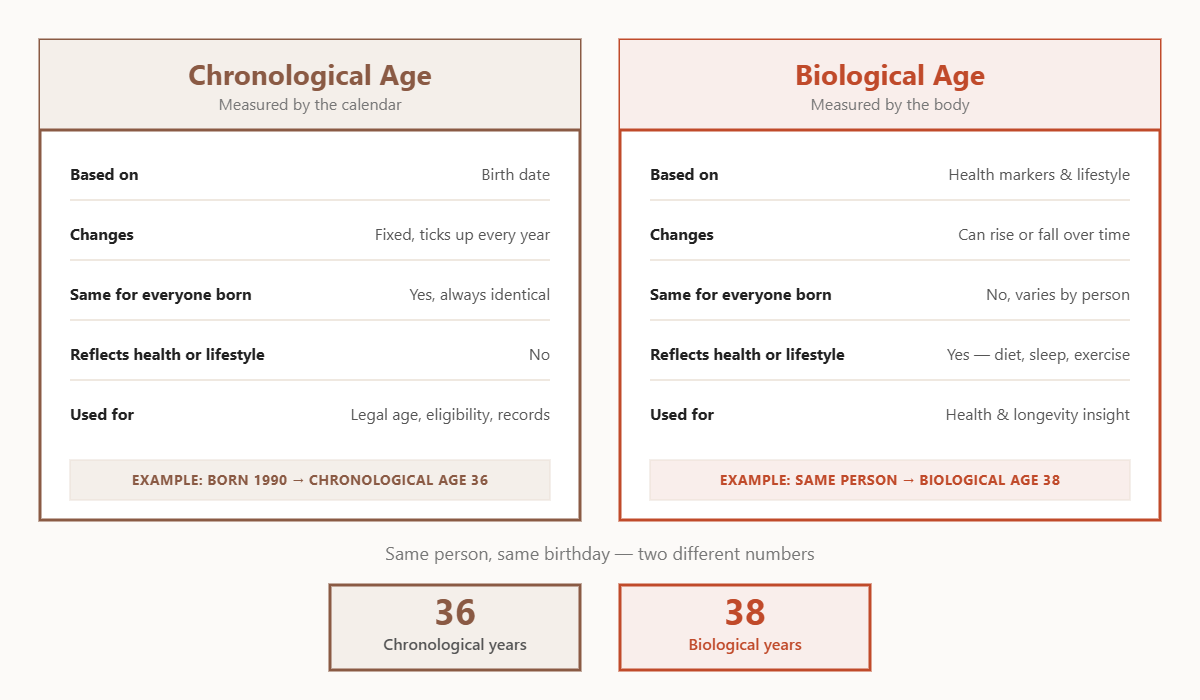
Chronological age is the actual amount of time that has passed since the day you were born. It’s the age this calculator measures. Biological age, on the other hand, describes how “old” your body is based on factors like your genes, lifestyle, overall health, and environment. This means two people with the same chronological age can have very different biological ages. Doctors may estimate biological age using tests that look at things like organ function, cell health, or other biological markers. While biological age is useful in health and aging research, chronological age is the one used for legal documents, school admissions, medical records, and growth charts.
How to Use This Chronological Age Calculator
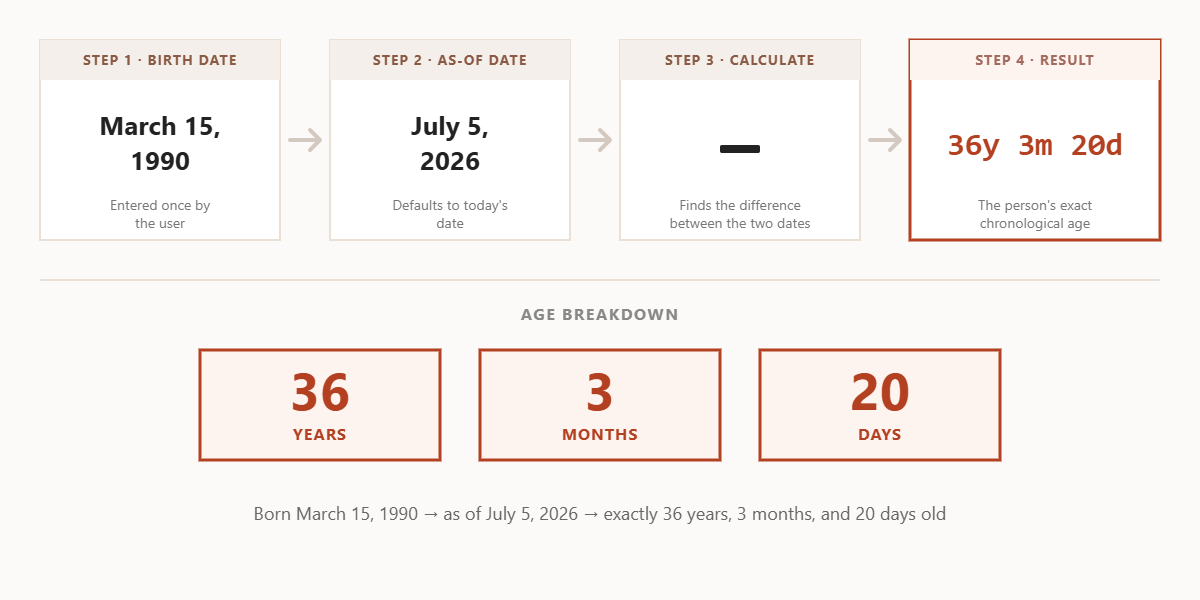
- Enter your Birth Date using the date picker or by typing in YYYY-MM-DD format. This is your date of birth as it appears on official documents.
- Set the “As of Date.” By default this is today, giving you your current exact age. Change it to any past or future date to calculate your age as of a specific date — for example, a school enrollment cutoff or a court filing date.
- Click “Calculate Age” (or simply change either date — the result updates automatically). Your precise age appears immediately in three formats.
- Read your results: the primary display shows years, months, and days; below that you’ll find total months and the full day count, precise age in days including every leap day.
- Reset anytime with the “Clear” button to start a fresh calculation for a different birth to present day calculation.
The date of birth age calculator works for any person born between January 1, 1000 CE and today, handling all historical leap year rules correctly.
Example Use Cases
School Enrollment Cut-Off
Many schools require children to be 5 or 6 years old by a specific cut-off date, such as September 1 or December 1, before they can enroll. Simply set the As of Date to your school’s cut-off date to check whether your child meets the age requirement. This is one of the most common reasons parents use a child age calculator.
Legal Age Verification
Many legal rights and requirements depend on your exact age on a specific date. This includes things like voting, getting a driver’s licence, signing contracts, claiming retirement benefits, or meeting the legal drinking age. Just enter the relevant As of Date to calculate your age accurately for official forms and age verification.
Medical Growth Chart Reference
Doctors use a child’s chronological age to compare their weight, height, and head circumference with standard growth charts. For babies born prematurely, they may also use corrected (adjusted) age to track development. This calculator provides the standard chronological age used on growth charts and in most medical records.