Child Age Calculator – Exact Age, Development & School Eligibility
Find your child’s exact age in years, months, weeks, and days. You can also check their next birthday countdown, development stage, and school eligibility—all in one easy-to-use calculator.
About this tool
One Simple Tool for Parents
Most parents have a good idea of how old their child is. But sometimes, you need the exact age. Whether you’re filling out a school enrollment form, visiting a pediatrician who asks for your baby’s age in weeks, or checking how many days are left until the next birthday, this free child age calculator gives you accurate results in seconds.
Enter your child’s date of birth, choose the date you want to calculate their age for (or simply use today’s date), and you’ll get a complete breakdown in years, months, weeks, and days. You’ll also see their next birthday countdown, development stage, school eligibility, and total age in months, weeks, and days—all in one place. No app to download and no account required; everything runs right in your browser.
How it works
How the Calculator Works
Our calculator takes two dates — your child’s date of birth and the date you want to calculate the age at. It then works out the difference with full calendar accuracy. That means it accounts for different month lengths (28, 29, 30, or 31 days), leap years, and February 29 birthdays.
What Each Result Means
- Years, Months & Days — Your child’s exact age shown in the format most people use, such as “4 years, 2 months, and 11 days.”
- Total Months, Weeks & Days — The total time since birth. This can be helpful for medical records, school forms, and early childhood assessments that ask for age in months or weeks.
- Development Stage — Shows your child’s current stage, such as newborn, infant, toddler, preschooler, school-age, or teenager, based on their age.
- School Eligibility — Gives you a quick idea of whether your child is likely to meet common school entry age requirements. Be sure to check your local school’s official cut-off dates.
- Next Birthday Countdown — Displays exactly how much time is left until your child’s next birthday, making it easy to plan celebrations or important milestones.
- Day of the Week Born — A fun detail that tells you which day of the week your child was born.

Why parents use it
Why Parents Use a Child Age Calculator
There are more situations than you might think where knowing your child’s exact age matters:
- School enrolment — many schools and programmes have age cut-offs measured in months, not just years.
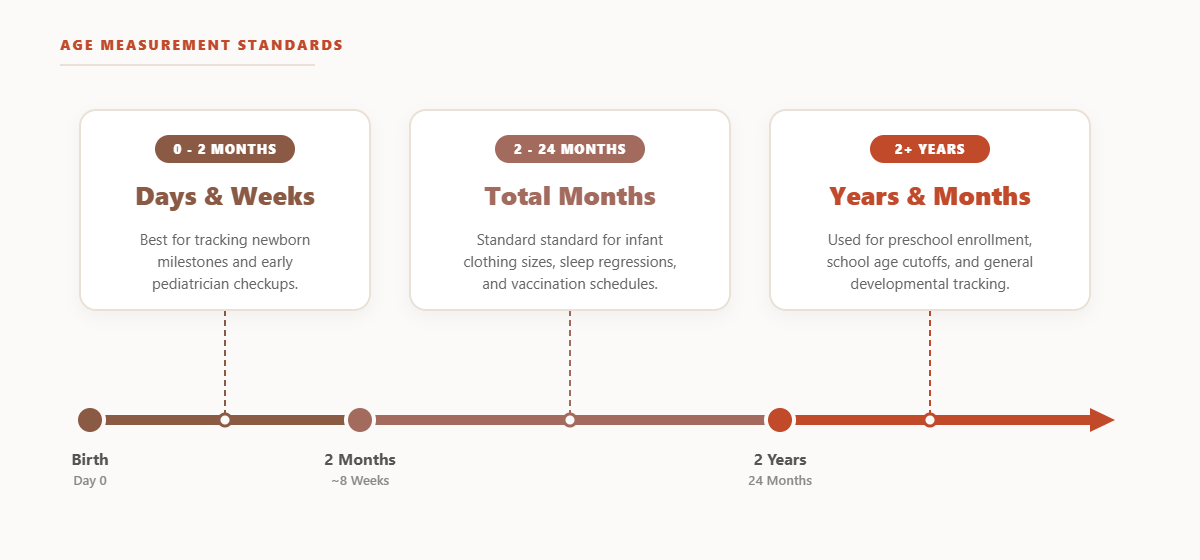
- Paediatric appointments — doctors often record age in months for children under two, and occasionally up to age five.
- Vaccination schedules — most immunisation schedules are based on months of age, not birthdays.
- Developmental tracking — books and apps that track milestones reference age in months. Knowing your child is “14 months” rather than “just over a year” helps you use those resources accurately.
- Legal documents — passport applications, custody agreements, and benefit claims sometimes require exact age in days or months.
- Sports and activities — youth leagues often have age cut-off dates. Knowing exactly where your child falls can determine which category they compete in.
- Just curious — sometimes a grandparent wants to know how many days old the new baby is. This answers that too.
Milestones explained
The Development Milestones Section
The milestone tracker shows seven key ages that come up often in child development:
| Milestone | Why It Matters |
|---|---|
| 6 Months | Typical start of solid foods, sitting with support, doubled birth weight |
| 1 Year | First birthday, walking beginning, transition from formula to whole milk |
| 18 Months | Key language development check, 15–20 word vocabulary expected |
| 2 Years | Two-word phrases, toddler independence, common check-up age |
| 3 Years | Pre-school age in most countries, toilet training usually complete |
| 5 Years | School starting age in many countries, reading readiness |
| 10 Years | Pre-teen stage, transition to upper primary school |
Examples
Quick Examples
Example 1 — Newborn
A baby born on 15 January 2025, calculated on 1 July 2025, is 5 months and 16 days old. In total months that’s 5, in total days it’s 167, and there are 198 days until the next birthday on 15 January 2026.
Example 2 — Toddler
A child born on 3 August 2022, calculated on 3 August 2025, is exactly 3 years old — 36 total months, 1,096 total days, and the 5-year milestone is 730 days away.
Example 3 — School age
A child born on 29 February 2020 (leap day), calculated on 1 March 2025, is 5 years and 1 day old. The next birthday (treated as 1 March 2026) is 365 days away.
Tips
Tips for Accurate Results
- Always use the exact date of birth from the birth certificate, not an approximate date.
- For newborns under a week old, the result will show 0 years, 0 months, and the exact number of days.
- If you need age for a specific future event (like a school cut-off date), change the “Age At Date” field to that future date.
- For twins or siblings, just run the calculator twice — once for each child’s date of birth.
- Age in total months is the most useful number for paediatric references — most developmental guides use months as their primary unit up to age 3.
Frequently Asked Questions
How is my child’s age calculated exactly?
The calculator counts the difference between the date of birth and the chosen date by working through full years, then full months, then remaining days. It accounts for the different number of days in each month and correctly handles leap years. The total day count is simply the raw number of days between the two dates.
What if my child was born on February 29?
February 29 birthdays are handled correctly. In non-leap years, the birthday is treated as March 1 for the purposes of the next birthday countdown and milestone date calculations. The age itself is still calculated accurately based on the exact date of birth.
Can I calculate my child’s age at a future date?
Yes. Change the “Age At Date” field to any future date — for example, the first day of school or a medical appointment — and the calculator will show how old your child will be on that day. This is useful for checking whether a child meets an age requirement for a specific program or cut-off date.
Why is age in months important for young children?
For children under three, development varies a lot month to month. A child who is 18 months old is at a very different developmental stage than one who is 24 months old, even though both are “under two.” Paediatricians, speech therapists, and developmental specialists all use months as their primary reference. Knowing your child’s age in total months helps you use those guides accurately.
How does the birthday countdown work?
The calculator finds the next occurrence of the birthday month and day from the “Age At Date” you’ve entered. If the birthday has already passed this year, it counts forward to next year. The result is the exact number of days remaining, with leap year February 29 birthdays handled as described above.
What does “Total Months” mean versus just “Months”?
“Months” in the main result is the remaining months after full years have been counted. So a child who is 2 years and 3 months old shows 2 years and 3 months. “Total Months” is the grand total from birth — 27 months in that example. Doctors and developmental records often use total months, especially for children under three.
How is school eligibility determined?
The school eligibility result is based on your child’s age compared with the selected date. Since school entry rules vary by country, state, and school district, always check your local authority’s official age requirements and enrollment cut-off dates.
How is my child’s development stage determined?
The calculator assigns a development stage based on your child’s chronological age. Common stages include newborn, infant, toddler, preschooler, school-age child, and teenager. These stages are general age ranges and are meant for informational purposes only.
Does the tool store my child’s information?
No. The calculator runs entirely in your browser. No data is sent to any server, stored in a database, or shared with anyone. The moment you close or refresh the page, the information is gone. This tool is completely private.
Can I use this for a newborn?
Yes. For a baby born today, the result will show 0 years, 0 months, 0 weeks, and 0 days. For a baby born a few days ago, you’ll see the exact number of days. The total days count is the most useful number in the early weeks, and all other features including the birthday countdown work correctly from birth.
What’s the difference between this and a general age calculator?
A general chronological age calculator works the same way mathematically, but this tool is built specifically for parents and caregivers. The wording, milestone tracker, and additional details are all focused on children. The milestones are drawn from common child development reference points, and the interface is designed to be clear and easy to use for everyday parenting purposes rather than professional use.
More Time & Date Tools
More Time & Date tools
Browse every free calculator in the Time & Date category.