Alcohol Dilution Calculator – Lab & Industrial
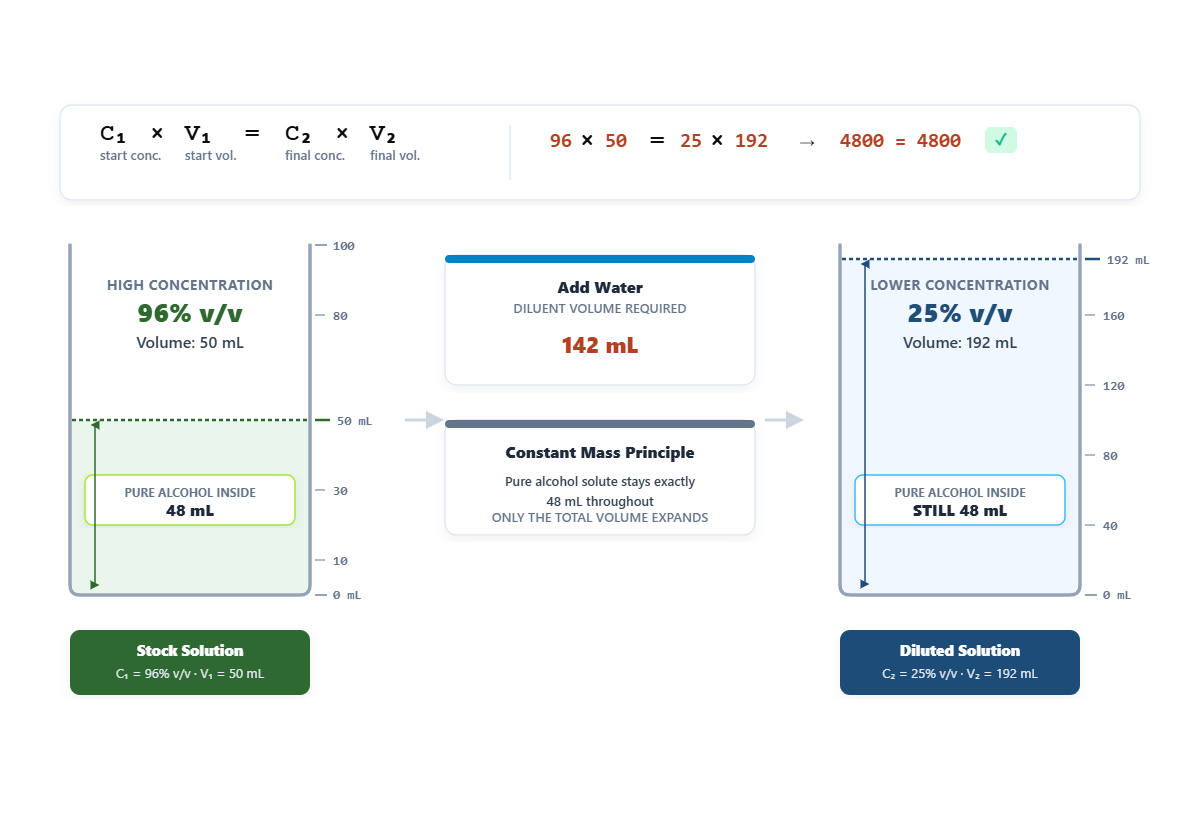
Use this Alcohol Dilution Calculator to prepare accurate alcohol solutions for laboratory work. It uses the C₁V₁ = C₂V₂ formula with temperature correction and specific gravity calculations to deliver results accurate to ±0.05% v/v.
Quick Guide
How to Use This Scientific Alcohol Dilution Calculator
This alcohol dilution calculator is designed for laboratory technicians, quality control chemists, and industrial formulators who need precise ethanol-water dilution calculations. Follow the four steps in the tool: select your units, optionally enable temperature correction, choose what you want to find, then enter your known values.
Units: Choose % v/v (the international laboratory standard), US Proof, or Specific Gravity (SG) depending on how your stock is labeled. Pick the volume unit your glassware uses.
Temperature correction: If your ethanol stock is measured at a temperature other than 20°C, enable this toggle and enter the actual temperature. The calculator applies a concentration-dependent k-factor model before running the dilution formula, preventing systematic errors that reach 1.3% v/v at 30°C for high-strength stocks.
Mode: “Water to add” is the most common workflow: you have a bottle of stock and want to know how much water to add. “Stock volume needed” works in reverse.
Values: Enter your three known quantities. The formula banner shows which variable is being solved. Tap Calculate to see results; expand the step-by-step section to audit every intermediate value for your batch record.
Learn the Basics
Understanding Alcohol Concentration Units (v/v, Proof, Specific Gravity)
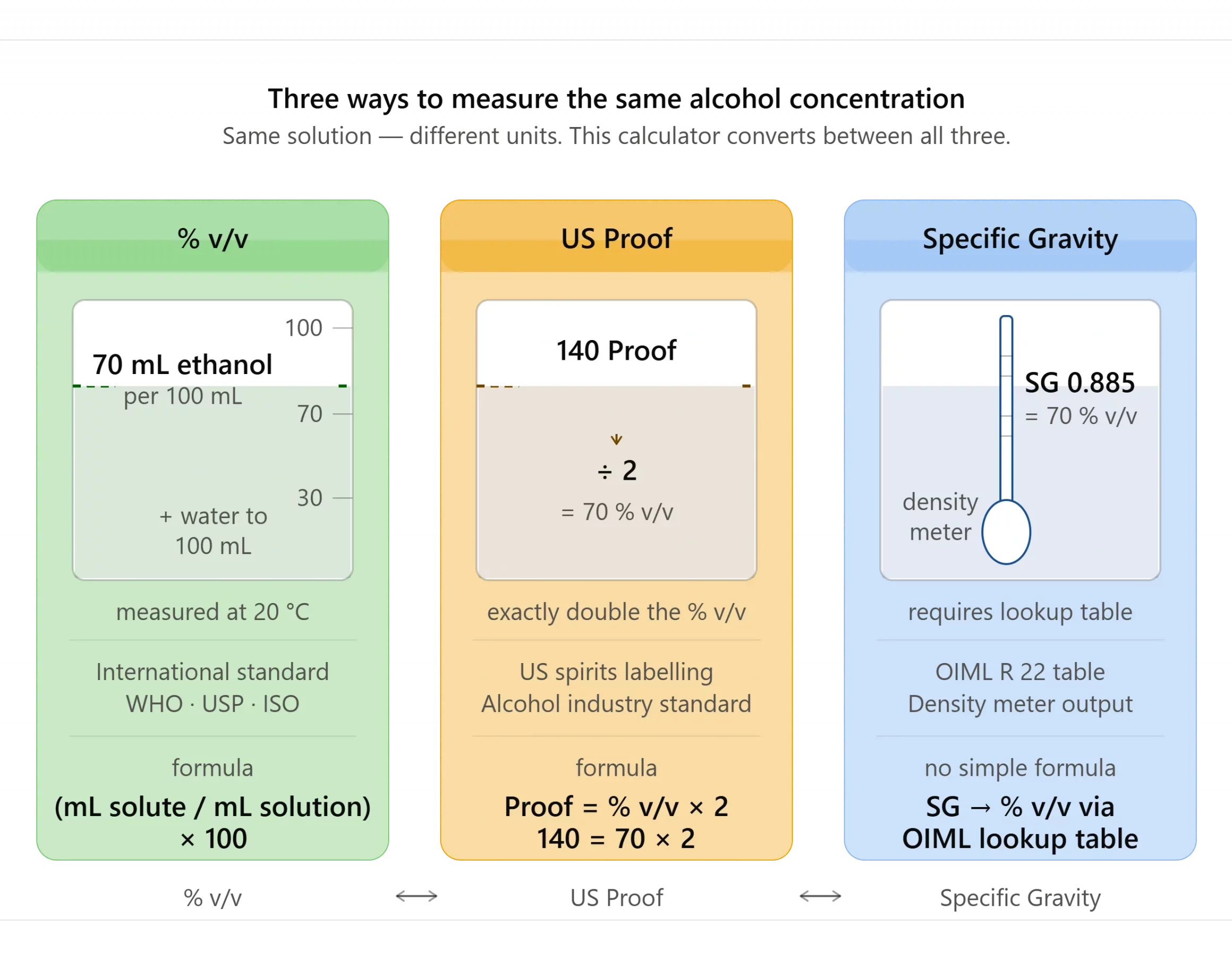
The % v/v (volume/volume) scale is the international standard for laboratory and pharmaceutical ethanol. It expresses millilitres of pure ethanol per 100 mL of solution at 20°C. WHO disinfectant formulations, USP monographs, and ISO standards all use % v/v.
US Proof equals exactly twice the % v/v value (190-proof grain neutral spirits = 95% v/v). This tool converts proof internally so all results trace back to the v/v scale.
The specific gravity alcohol dilution method uses density measurements from a hydrometer or digital density meter. The tool applies a 26-point OIML R 22 lookup table with monotone cubic interpolation, giving accuracy within ±0.3% v/v across the full 0–100% v/v range.
Accuracy Matters
Why Temperature Correction Matters
Ethanol has a thermal expansion coefficient roughly three times that of water. At 30°C, a solution that appears to be 95% v/v actually measures closer to 93.7% v/v when referenced back to 20°C — a 1.3 percentage-point discrepancy that can invalidate a disinfectant formulation or cause a pharmaceutical batch to fail specification.
This temperature correction alcohol volume tool uses a piecewise concentration-dependent k-factor model rather than a single universal coefficient. At low concentrations (below 20% v/v), k ≈ 0.00040/°C; at high concentrations (above 85% v/v), k rises to 0.00078–0.00082/°C.
Common Dilution Examples
- 70% v/v from 95% v/v stock: WHO surface disinfectant. With 1000 mL stock, add ≈357 mL water.
- 80% v/v from 96% v/v USP grade: Enter C₁ = 96, C₂ = 80, V₁ = 500 mL.
- 1 L of 30% v/v from absolute ethanol (99.9%): Switch to “Stock volume needed”, V₂ = 1000 mL.
- SG workflow: Read SG 0.877 at 25°C, enable temperature correction.
- Micro-scale prep: Select µL for HPLC mobile phase modifiers.
For general solution dilutions (acids, bases, buffers), see our Dilution Calculator — it handles molar, mass/volume, and % w/v without the ethanol-specific corrections.
Frequently Asked Questions
Why does C₁V₁ = C₂V₂ differ from gravimetric calculation?
How accurate is the SG to % v/v conversion?
Can I use this for isopropanol (IPA)?
How do I prepare 70% ethanol from denatured alcohol?
How do I convert Fahrenheit for the temperature field?
Why add water incrementally rather than all at once?
Tips for Accurate Dilutions
- Use Class A volumetric glassware — graduated cylinders carry ±0.5–1% volumetric error.
- Allow the mixture to equilibrate to 20°C before taking a hydrometer reading.
- For highest accuracy, prepare gravimetrically and verify with a NIST-traceable density meter.
- Record all inputs, temperature, mode, and outputs in your batch manufacturing record.
- Rinse glassware with a small portion of stock before measuring to prevent dilution from residual water.
This alcohol dilution calculator is provided for educational and laboratory reference purposes only. Results are based on theoretical dilution equations and approximated physicochemical data. All calculations must be verified by a qualified chemist before use in pharmaceutical manufacturing, regulated industrial processes, or safety-critical applications.