
UUID Generator – Online UUID v4 Tool
Quickly generate RFC 4122 compliant UUIDs instantly in your browser — v4 random or v1 timestamp, single or bulk up to 100, with export to CSV, TXT, and JSON. Also, validate existing UUIDs or generate deterministic v3/v5 hashes from a namespace and name. No server, no sign-up, nothing stored.
What is it
What is a UUID Generator?
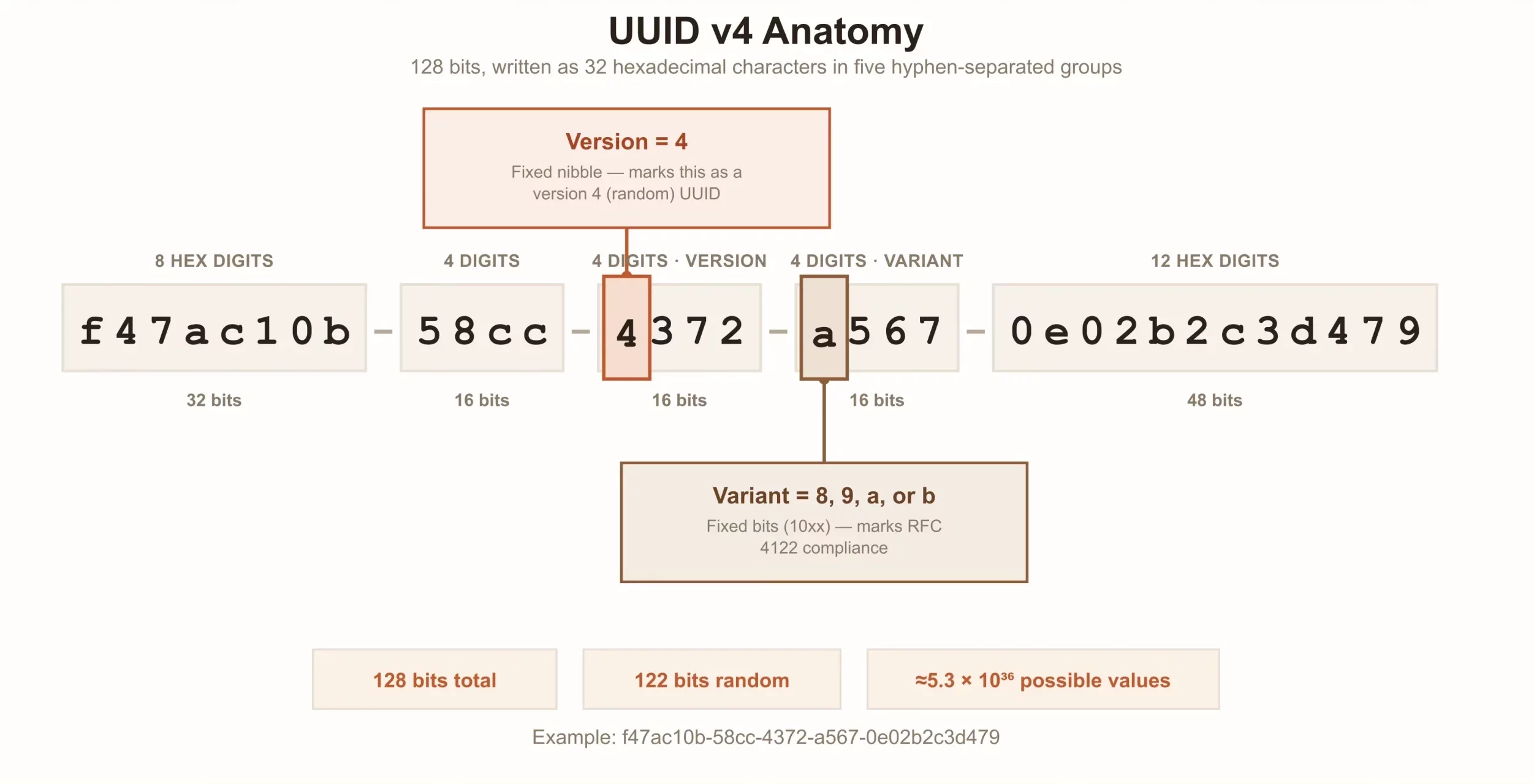
A UUID generator is a tool that creates a Universally Unique Identifier — a 128-bit value represented as 32 hexadecimal digits in five hyphen-separated groups, such as 123e4567-e89b-12d3-a456-426614174000. This tool supports v4 random UUIDs (cryptographically secure, 122 bits of entropy), v1 timestamp UUIDs (time and node-based, RFC 4122 Appendix C), and deterministic v3/v5 hash UUIDs generated from a namespace and name pair using MD5 or SHA-1.
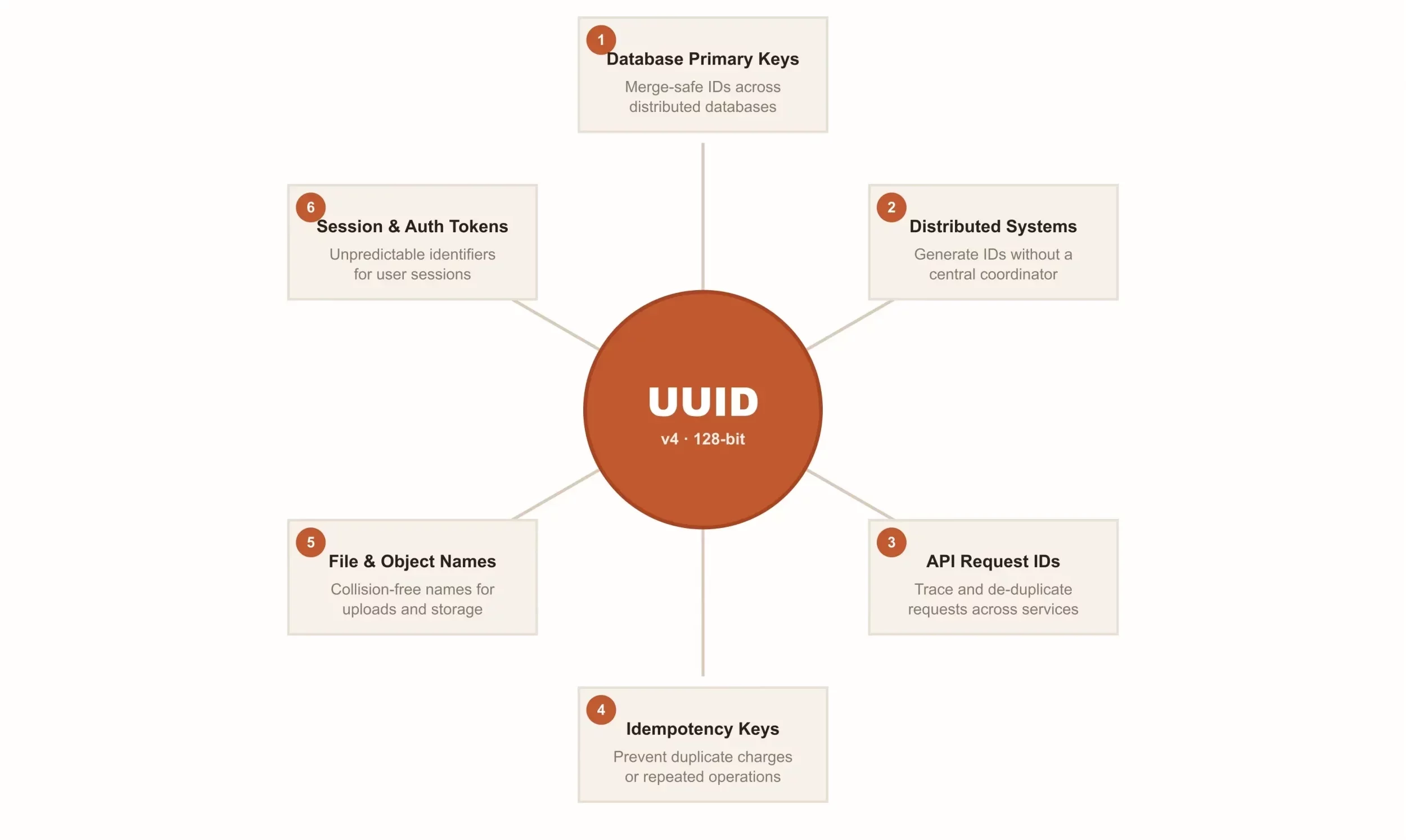
UUIDs are used as primary keys in databases, identifiers in distributed systems, session tokens, file names, API request IDs, and correlation references anywhere a globally unique value is needed without a central issuing authority. You can bulk generate up to 100 UUIDs at once and exports them as CSV, TXT, or JSON. Also, our validator checks any UUID string against the RFC 4122 spec — version nibble, variant bits, character set, and length — and returns a full breakdown of the result.
Step-by-step guide
How to Use This UUID Generator
Five tabs, each built for a different use case:
- Single UUID — A UUID generates automatically on load. Switch between v4 random and v1 timestamp, choose a format (standard, no hyphens, braces, URN, or Base64), toggle uppercase, and enable part highlighting to see the version nibble, variant bits, and random segments colour-coded. The anatomy card below explains each segment of the current UUID.
- Bulk Generate — Pick a count (1–100), version, and format, then click Generate. Each UUID gets its own copy button. Export the full list as CSV, TXT, or JSON in one click.
- Validate — Paste any UUID string and click Validate. The tool checks RFC 4122 format, version nibble, variant bits, character set, and length, then returns a full breakdown including version, variant, case, and hex character count.
- v3 / v5 Hash — Generate a deterministic UUID from a namespace (DNS, URL, OID, X.500, or a custom UUID) and a name string. v5 uses SHA-1 via the Web Crypto API; v3 uses MD5. The same inputs always produce the same UUID — useful for stable database keys and named resources.
- History — Every UUID generated in the current session appears here, tagged by version and time. Copy all or clear the list at any time. Nothing is stored beyond the current browser session.
Versions compared
UUID Versions Compared
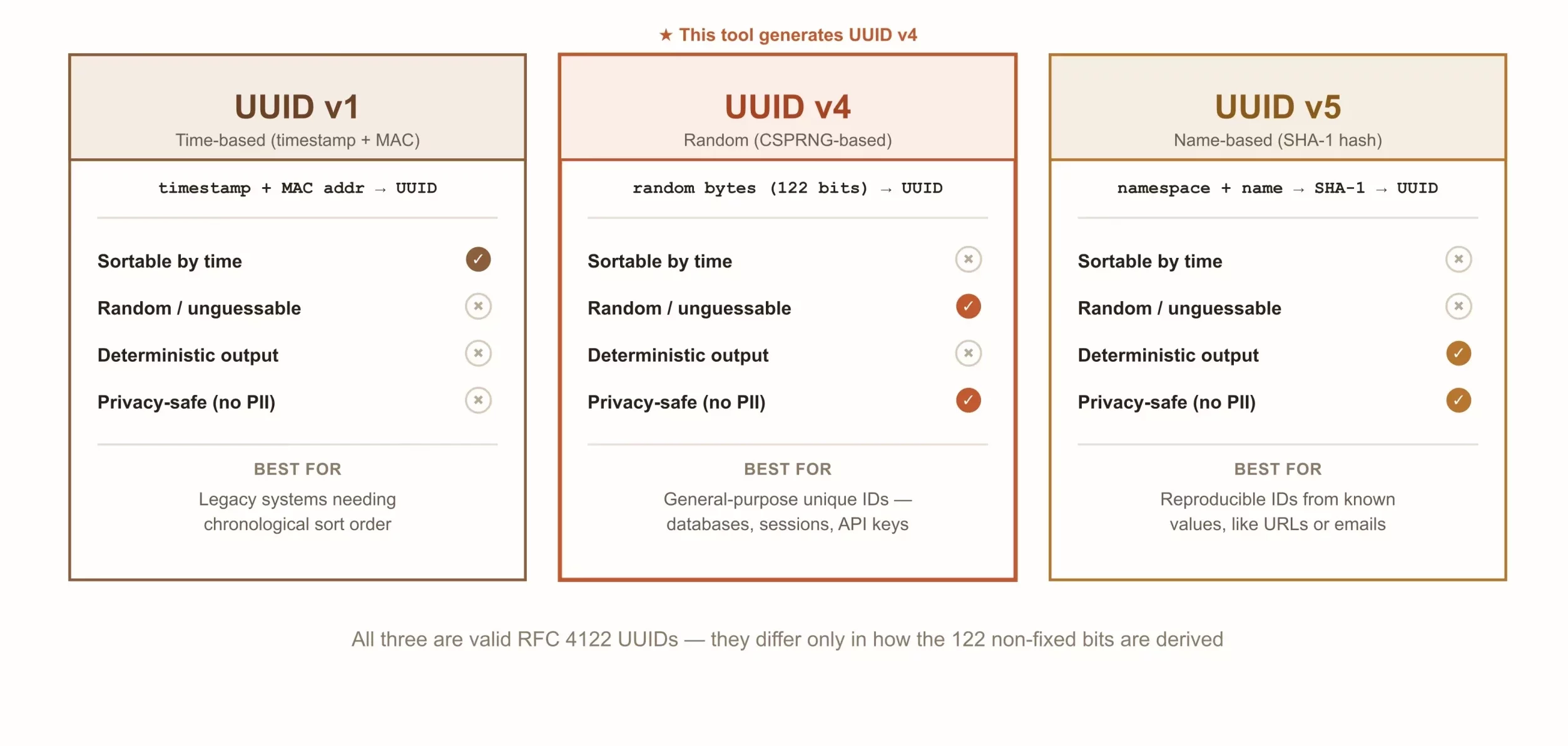
The UUID specification defines five versions. This tool supports v1, v3, v4, and v5 — here is how they differ:
| Version | Generation Method | Deterministic | Common Use |
|---|---|---|---|
| UUID v1 | 60-bit timestamp + clock sequence + node (MAC address) | No | Time-sortable IDs in legacy systems — avoid in new builds due to embedded hardware info |
| UUID v3 | MD5 hash of a namespace UUID + name string | Yes | Stable IDs from named inputs where SHA-1 is unavailable; generally superseded by v5 |
| UUID v4 | 122 bits of cryptographically secure random data | No | General-purpose unique identifiers; the most widely used version today |
| UUID v5 | SHA-1 hash of a namespace UUID + name string | Yes | Stable, reproducible IDs for URLs, DNS names, database records, and named resources |
However, v4 remains the default for most applications. Because it needs no input, carries no hardware information, and its 122 random bits make collisions negligible in practice. You can use v5 when you need the same UUID to be reproducible from the same input, and v1 only when time-sortability is a hard requirement in an existing system.
Frequently Asked Questions
What is a UUID used for?
UUIDs are used to uniquely identify information without requiring a central authority to issue or track values. Common applications include database primary keys, distributed system identifiers, session and transaction IDs, file and object names in storage systems, API request IDs, and correlation IDs for tracing requests across microservices. The bulk export feature in this tool is specifically designed for seeding databases and generating test fixture data at scale.
Are UUIDs always unique?
For all practical purposes, yes. A UUID v4 has 122 random bits, giving roughly 5.3 × 10³⁶ possible values — generating a billion UUIDs per second for a trillion years would still leave the collision probability negligibly small. v1 UUIDs are unique by construction (timestamp + node), and v3/v5 UUIDs are deterministic, so the same input always produces the same output rather than risking a random collision.
Can I generate a UUID in JavaScript?
Yes. Modern browsers and Node.js support the built-in crypto.randomUUID() method, which returns a cryptographically secure UUID v4 string with no external libraries required. This tool uses that exact method for v4 generation. For v1, it derives a timestamp-based UUID client-side. For v5, it uses crypto.subtle.digest('SHA-1', ...) from the Web Crypto API, and for v3 it runs a pure-JS MD5 implementation — all entirely in your browser.
Is this the same as a GUID?
Yes. GUID (Globally Unique Identifier) is Microsoft’s term for the same concept. The formats are functionally identical — a 128-bit value displayed as 32 hexadecimal characters in five hyphen-separated groups. A GUID generator and a UUID generator produce values that follow the same RFC 4122 structure and can be used interchangeably across platforms and languages.
What is a deterministic UUID and when should I use one?
A deterministic UUID (v3 or v5) is generated by hashing a namespace UUID together with a name string. The key property is that the same namespace and name always produce the same UUID — making it reproducible without storing it. This is useful when you need a stable ID for a known resource, such as generating a consistent UUID for a URL, a user email address, or a product SKU. Use v5 (SHA-1) for new systems; v3 (MD5) exists for legacy compatibility only.
How does the UUID validator work?
The validator checks a UUID string against the RFC 4122 specification. It verifies the overall length (36 characters including hyphens), correct hyphen positions, valid hexadecimal characters throughout, the version nibble (bits 12–15 of the third group, must be 1–5), and the variant bits (bits 64–65 of the fourth group, must be 8, 9, a, or b for RFC 4122 UUIDs). It then returns the detected version, variant, case, and hex character count.
For developers
Developer Use Cases
Developers commonly use this tool to quickly generate placeholder IDs for test data, populate database seed scripts, create unique keys for React or Vue component lists, generate API keys or tokens for local development, name temporary files or cache entries, and produce sample records for demos and documentation. The bulk generation feature is especially useful when seeding a table with dozens of unique records at once.
crypto.randomUUID() uses a cryptographically secure random number generator, this tool is intended for general development, testing, and identification purposes. It should not be relied upon as a substitute for dedicated cryptographic key generation or security tokens in production authentication systems.
More Developer Tools
More developer tools
Browse every free tool in the Developer Tools category — UUID, Binary, and more.