Cups to Grams
Converter
Precise kitchen conversions for 35+ ingredients — switch between cups & grams instantly. Built for bakers, home cooks, and recipe developers.
How to Use This Converter
Pick an Ingredient
Select from 35+ common baking & cooking ingredients, each with precise density values.
Choose Cup Size
US, Metric, UK, or Australian cup — because a cup isn’t always the same cup around the world.
Enter Your Amount
Type the number of cups (or grams). The result updates instantly as you type.
Swap Directions
Hit the ⇄ button to switch between Cups→Grams and Grams→Cups at any time.
Pick an Ingredient
Select from 35+ common baking & cooking ingredients, each with precise density values.
Choose Cup Size
US, Metric, UK, or Australian cup — because a cup isn’t always the same cup around the world.
Enter Your Amount
Type the number of cups (or grams). The result updates instantly as you type.
Swap Directions
Hit the ⇄ button to switch between Cups→Grams and Grams→Cups at any time.
Baking guide
Cups to Grams Converter — Complete Baking Guide
Whether you’re scaling a recipe from an American cookbook or converting a European formula for your kitchen, our cups to grams converter gives you pinpoint accuracy for every ingredient. Measuring by weight rather than volume is the gold standard for baking precision, and this tool makes that effortless. Just pick an ingredient, choose your cup size, and read the result instantly.
Why convert cups to grams?
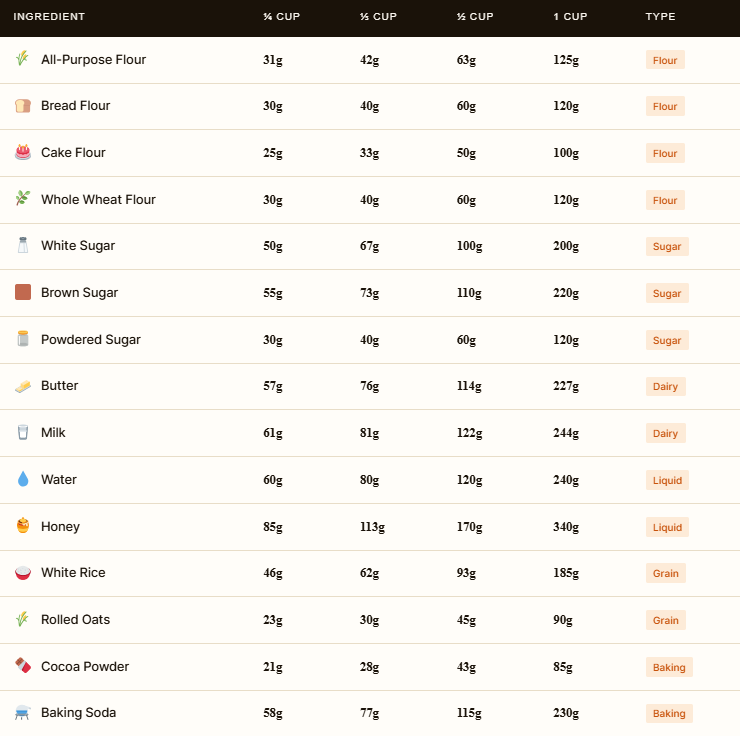
If we take one cup of all-purpose flour, which weighs around 125g, and one cup of honey, which weighs 340g. This demonstrates a significant difference—honey is almost three times heavier than flour, even when measured by the same cup volume. That’s why measuring ingredients in grams offers several important advantages over using cups.
- Better Accuracy: Weighing ingredients in grams ensures far more precise measurements than using volume-based tools. This is especially important because cup sizes and measurement standards can vary from country to country, leading to inconsistent results.
- Consistent Results: Using grams helps you recreate recipes with the same texture, flavor, and appearance every time you bake.
- Professional Standard: Most chefs, bakeries, and modern recipes use grams because they provide reliable, repeatable results.
- Fewer Measuring Errors: Measuring by weight eliminates variations caused by packed flour, settled ingredients, or different measuring techniques.
Common cups to grams conversions
US vs. metric vs. UK cups — what’s the difference?
Did you know not all “cups” are created equal? A standard US cup holds 236.6 ml (about 240 ml), while a metric cup—common in Australia, Canada, and much of the world—contains exactly 250 ml. Over in the UK, a traditional cup measures 284 ml, which is half an imperial pint. Our converter takes all these differences into account, so no matter where your recipe comes from, you’ll always get the right result.
- US cup — 236.6 ml, used throughout North American recipes
- Metric cup — exactly 250 ml, common in Australia and continental Europe
- UK cup — 284 ml, an older imperial standard, rarely used today
- AUS cup — 250 ml, identical to the metric cup
Frequently asked questions
How many grams are in 1 cup of flour?
1 US cup of all-purpose flour weighs approximately 125 grams. This can vary slightly depending on how the flour is scooped — spooning it loosely into the cup and levelling it off gives the most accurate result.
Is it better to measure by cups or grams for baking?
Grams are always more accurate for baking. Cups measure volume, which changes based on how tightly an ingredient is packed. Weighing ingredients removes that variability and ensures consistent results every time.
How many grams is 1 cup of sugar?
1 US cup of granulated white sugar equals approximately 200 grams. Packed brown sugar is around 220 grams per cup, while powdered sugar is lighter at about 120 grams per cup.
Why do different ingredients have different cup-to-gram conversions?
Each ingredient has a unique density — its mass per unit of volume. Dense ingredients like honey or butter weigh far more per cup than light, airy ingredients like powdered sugar or cocoa powder. This tool uses tested density values for each ingredient to keep the math accurate.
Can I use this tool for liquids like milk and water?
Yes — water and milk are both included. Water follows the simple rule of 1 ml = 1 g, so 1 US cup of water equals 240 g. Milk is slightly denser at about 244 g per cup.
Related calculators
Explore other tools
Need more kitchen conversions?
Browse every free converter and calculator in the Food & Kitchen category.